On Prophecy and Best-Laid Plans
Adventures in Sobriety and Late-night Fandom
(Download Story as PDF; not yet updated in light of recent access to bodycam footage)
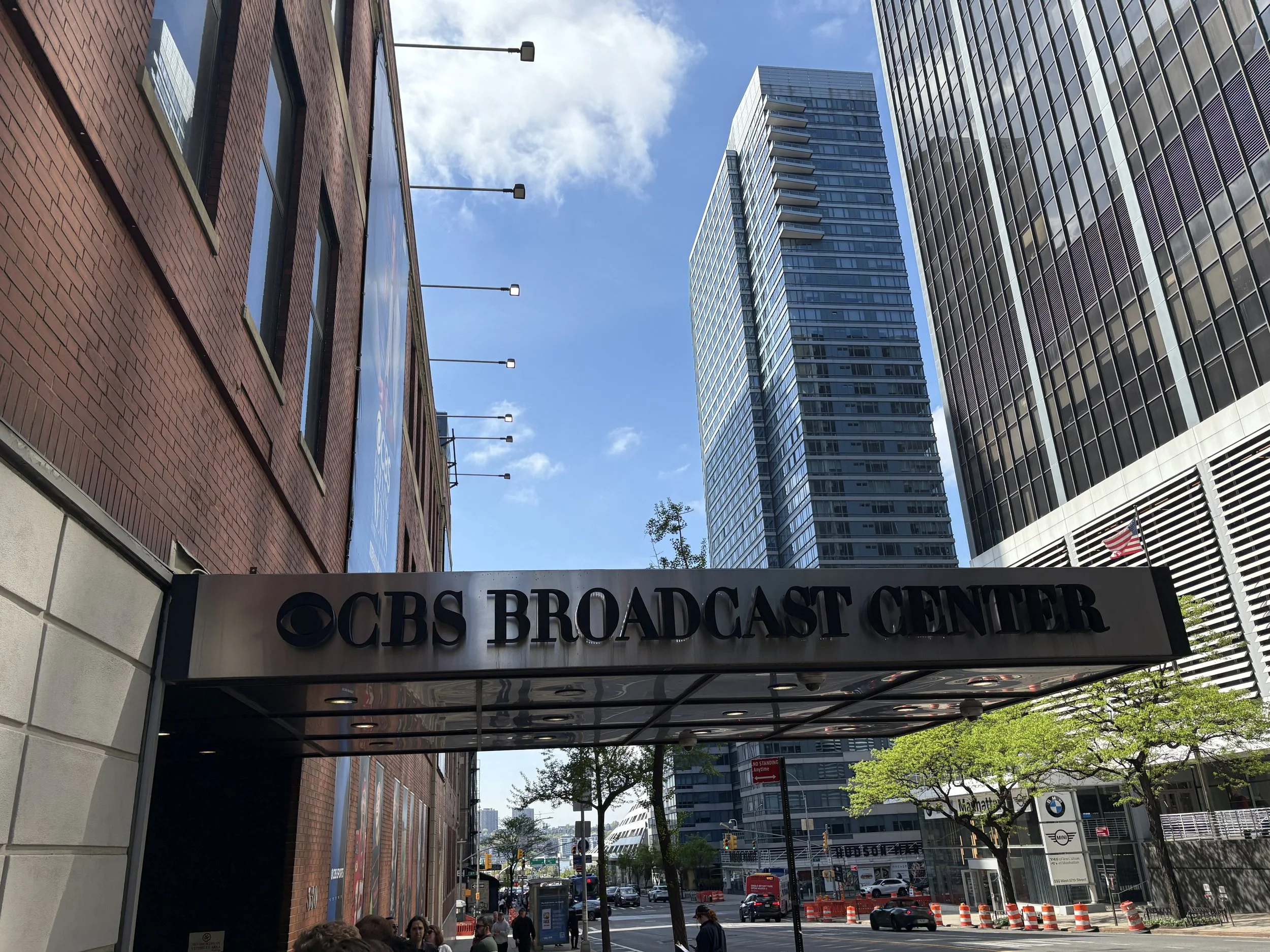
The CBS Broadcast Center in Manhattan, where this whole crazy saga kicked off, back on January 14th, 2024.
-
May 25th, 2026
It’s weird how life suddenly pivots around certain key days, which are often unforeseeable in advance. A Monday is just a Monday until something astounding happens, from which you thereafter date and periodize the rest of your life, into times “before” and “after.” A tragic loss. An unexpected joy. A personal triumph at work. A blow-up fight with a valued friend, from which the relationship never recovers. Or, if you’re me, on a certain Monday last April, it could be the day you emptied handle of whiskey down the drain of the kitchen sink. The day you finally quit drinking.
This has been a hell of a month. I reached a full year’s sobriety in late April, 2026, and to celebrate I went down to New York a few times and saw all of my favorite TV shows, in-person. Last Week Tonight with John Oliver, Late Night with Seth Meyers, The Daily Show (twice, first with Michael Kosta, then with Desi Lydic), and The Late Show with Stephen Colbert. While I was down there, I also saw a few stand-up shows featuring late-night TV comedians. It was a total blast, and I’ll definitely circle back to write more on this topic in the future, and to substantively explore the differences among the actual production approaches I saw.
But for this first pass reflecting on the adventures, I want to highlight my (admittedly unusual) internal experience as a fan. You see, I love asking questions during Q&A, and getting picked out for crowd work and jokes, which happens to me a lot when I attend these shows. And, as you’ll start to understand as you read this thing, I have an utterly unique personal framework for how I relate to and think about these particular TV shows, which informs why I chose this late-night circuit for my sobriety anniversary in the first place.
So, throughout the rest of this piece, we’ll follow key aspects of my mental experience, rather than adhering to a strictly linear or exhaustive plot. We’ll take the shows themselves day-by-day, but I’ll primarily aim to trace certain critical interactions I had with the shows’ hosts and staff, from which I could not help but draw meaningful connections to deeply significant moments past—powerful memories that I re-lived at the shows, again and again this month—scenes and words from the strangest day of my life: January 14th, 2024.
The day I spoke the future.
-
April 18th, 2026.
CBS Broadcast Center, Manhattan.
“Yes, you there,” said John Oliver, pointing at me as soon as I raised my hand.
“Me?” I verified, gesturing at myself and excitedly re-adjusting my pink-eared Jigglypuff hat (which I wear to all the shows). I was thrilled to be chosen for the Q&A. And I was ready.
“Yeah,” Oliver said, nodding encouragingly.
Excellent. I asked my question.
“What’s the single strangest fan interaction that’s ever happened at the studio?”
The audience broke into laughter at my question. It was a good one. Oliver himself looked down and cracked up a bit, pausing to think for a few seconds, and then glancing back up at me, to say:
“That feels like a direct challenge.”
(More laughter.)
And it was. I wanted to see him to think on his feet.
Not because I thought it would be hard for Oliver to think of the answer. Quite the opposite. I knew exactly what the answer really was. But I also knew that the true answer could not yet be spoken openly to a live studio audience—and, further, I knew that the answer would be so blisteringly obvious to Oliver (in that moment) that it would be almost impossible for him to think of anything else to say on-topic.
And I was right: he sidestepped the question and told a tangentially-related anecdote.
But, well…of course I was right.
The question was self-referential.
You see, the strangest fan-interaction in studio history…
It was me.
***
January 14th, 2024
CBS Broadcast CenterOn January 14th, 2024, first thing in the morning, I walked into the lobby of the CBS Broadcast Center in New York, where Last Week Tonight is filmed, and I asked to speak with a writer for John Oliver (or perhaps Stephen Colbert), because I wanted to discuss potential reforms to the present iteration of capitalism.
CBS called the cops on me.
They reported me as a dangerous crazy-person.
Apparently, that was a dangerously crazy thing to have suggested.
Now, admittedly, showing up at 7:00am, without an appointment, while wearing a Jigglypuff hat might have been an impractical approach. Still, though. They could have said “please, go away” when I explained my objectives. Instead of saying “wait here,” so they could have me flushed. Remaindered to the state mental health system.
So, no.
Calling the cops on me was some bullshit.
Nevertheless…that morning at CBS…
I was fucking magnificent.
I got on my damn soapbox and stood proudly and passionately on principle:
“I am a citizen dissatisfied with the performance of my government,” I said. “And I am here seeking peaceful redress of certain grievances by means of reasonable political discourse. I am attempting to avail myself of the free press, of which I hold CBS and John Oliver to be exemplars. I came here, to this building, because I think I may have stumbled onto something that’s potentially important to the national public discourse, particularly during the currently-unfolding election season, and because it’s a bit over my head. So, I wanted to pass this thing off to someone else—someone responsible, who might be able to handle it properly—in case I have what I think I do.”
I was really rolling now, and I was getting pretty animated, as I built to the main point.
“Someone in this building,” I said, gesturing dramatically at the bank of security cameras positioned directly above us, “has spent millions upon millions of dollars over the past decade to broadcast a certain very specific rhetorical ethos, namely: that this building, and this company, are where smart people should bring Big Ideas that the world might need to hear—especially when those people might be onto something that’s a little out of their depth. So, taking Oliver and CBS at their word, I have come here with a Big Idea, to try to talk to someone.
“I figured someone in the building would want to hear what I had to say. Or at least ask a follow-up question! I mean, really. Which competitor would CBS have preferred for me to try?”
At one point that morning, the paramedic raised an eyebrow. Speaking slowly, she asked:
“Sir…do you know what day of the week it is?”
I did not.
(I said I was magnificent that day.
Not perfect.
And it was about to be a very long day.)
-
April 19th, 2026
The Beacon Theater, Manhattan
“Thank you to the one person who clapped,” said Seth Meyers, looking directly at me. I was doubled-over laughing after a particularly brutal joke he’d just told about his kids’ reaction to the death of their dog. Most of the crowd groaned, but I was all-in on the joke. “What happened?” continued Meyers. “Did an old witch curse you, to be able to clap twice at some point, and reverse the flow of time thirty seconds, and erase an awful joke?”
Seth was hilarious. Of course he was. He always is. I’ve loved his work for years.
Even if he wasn’t exactly the right fit for the project that I’d originally had in mind, that strange morning a couple years prior, when I walked into the lobby of CBS.
***
January 14th, 2024
CBS Broadcast Center
“You mentioned competitors. What about the other late-night shows? You could try them.”
“Yeah, maybe,” I said. “I mean, I did mention Colbert earlier. Oliver seemed like the right match, but maybe another show would work. I know they’re all friends—they did their Strike Force Five podcast during the writers’ strike—and they’re all roughly politically aligned. Heck, maybe they’re still working as a team. You could totally do that. Deliberately channel their back-room influence toward giving Oliver all the Emmy wins (not that he needs the help), or even just feed him their big-stunt or deep-dive ideas, which would give his show a pretty gnarly signal-boost and excellent protection against cancellation, and it’d support his ability to tackle things that wouldn’t work for the nightly formats. Oliver certainly has the freedom to try some wild things—like the Idea I wanted to talk about. Actually, hell, it might even be a good idea to try to keep Oliver’s show somewhat insulated from the direct, day-to-day clusterfuck of actual electoral politics during an election year, to improve the broader appeal of his other pieces. I mean, the election is important, but people already know and hate both of these candidates; and I don’t know about you, but I already know who I’m voting for—unless something totally crazy happens. There’s nothing much for any of us to learn about these two candidates, so it seems like Oliver could focus on other things. And, honestly, I said my Big Idea was relevant to the election—and it is—but it’s not precisely politics, or at least not electoral politics. There are more important things than politics in play.
“Now, Seth Meyers is definitely an option, for sure. It makes sense to have one player on the team who’s really good at rallying-the-troops, if you will, and that would appear to be Seth Meyers in this case. Meyers’ show is super fucking political and is pretty damn entertaining. I love A Closer Look—I watch it every day. But I don’t think it’s quite the right stylistic fit for this project. The writing style is a little bit too combative and confrontational for this particular idea that I have in mind. Not that I usually disagree with A Closer Look all that much—it’s clever as hell—but it’s more of a preaching-to-the-choir vibe, a little akin to Maddow or someone like that (though not so far gone). But having someone to boost team morale and energize the base is a good idea, which seems to be Meyers. Still, Meyers’ show probably isn’t quite the right fit—even if his sub-show, Corrections is the funniest fucking thing on YouTube. I mean, what am I going to do? Post a correction that reads: Dear Seth, Correction: Capitalism?”
I gestured dramatically, as if writing out the words mid-air.
Quite frankly, I was hilarious that morning, which is probably a big part of why the cops just sent me on my way after a few minutes, with a smile and directions, instead of carting me off to the no-pants wing of the hospital, in the shiny ambulance they’d brought with them for precisely that purpose.
“Anyway, I seem to have struck out here, so…I could still go to Meyers, and maybe I will. I just know Oliver and Colbert the best. But I’m not crazy. I’m just a little excitable and weird.”
“I’m beginning to see that,” the officer said. “But…you understand why they called us, right?”
“Not really,” I responded. “I mean, would you like me to leave? Nobody has yet instructed me to do so, so I’m not sure why they called you. I’d be happy to head out, if I’m making people nervous.”
“Yeah, that’s probably for the best,” she said.
“Alright. No worries. I’ll go. Sorry you got called out here for nothing.”
“Where do you think you’re headed, if you don’t mind my asking?”
“I’ll probably go swing by NBC and try my luck there. And if that doesn’t work, I’ll probably hop an Acela back to Boston. Actually, I might well file a lawsuit against CBS when I get home for reckless endangerment. Not that you lot did anything wrong by showing up when they called. You were great and very professional. But I have the resources and plenty of spare time, and I’m kind of irritated with CBS at the moment.”
“Understandable. Have you considered trying to contact any of these shows on social media? Maybe you could post something on TikTok and go a little viral yourself?”
“Yeah, the guy at the desk mentioned social media. But, you know, oddly enough, ‘viral’ is exactly the last thing I want to go. It’s hard to explain. But social media is just not the right approach for something nuanced like this.”
“Okay, I get that. Well, good luck.”
“Thanks. Oh, wait. Actually. How do I get to 30 Rock?”
And I danced off down the sidewalk. Headed toward NBC.
-
April 19th, 2026
The Beacon Theater
“What a mortifying thing to be the only person to clap for,” said Oliver, laughing at me in front of the theater full of people. The crowd joined in, roaring at my ridiculousness. But, just like with Meyers, I wasn’t embarrassed at all. In fact, I was delighted. You see, the reason I was already clapping was that I was ahead of John Oliver’s joke. I knew exactly where he was going. It’s a seldom-used, but ironclad rule of comedy: if you, as a stand-up comedian, introduce the bizarre historical tidbit that the Allies (during World War I) discovered that human semen can be used as invisible ink…then you’re going to mention the name of the guy who somehow stumbled upon that knowledge: Mansfield Cumming.
(I call that rule Chekhov’s Goon.)
But seriously. How could I not clap for that, as soon as I saw where we were headed?
I think a lot like John Oliver.
I talk like him, too: fast and pedantic, often overly enthusiastic, and typically gleeful to make the oh-so-clever joke.
Hell, I’ve been told I even kind of look like John Oliver, though I suppose that’s more a matter of opinion. But I’d agree. I definitely have a big nose and glasses. And I’m pretty sure I’ll follow his timeline of graying hair over the next few years. Immaculate nerdy-looking white-guy vibes, the both of us.
But, anyway…I really do think a lot like John Oliver.
In quite a few ways.
***
January 14th, 2024
The Acela Express
“Someone should offer Clarence Thomas a million dollars a year to fucking retire.”
I made that suggestion somewhere in Connecticut, a few hours after the incident at CBS. I was on the Acela Express—train #2248, if you care—talking to Daily Show writer and producer Matt O’Brien, and showrunner Jen Flanz. O’Brien and Flanz had come to intercept me, after learning of my little performance in front of CBS earlier that morning (and after seeing the security tapes). They’d actually caught up to me almost immediately at the train station, but they didn’t identify themselves explicitly at first. They used fake names for the first-contact (“Josh” and “Tamara”). Admittedly, I’m a little…different…and I’m not at all good at reading people, so it took me a pretty long time to figure out who they were (and who they worked for). But I got there eventually—even if I didn’t have their real names until I looked them up online much later. The three of us talked for hours on end that day, all the way back to Boston.
I did most of the talking.
I told them everything about myself. My life. My dreams. My nightmares.
And I told them some fucking great ideas for TV. Like that Clarence Thomas thing—which I thought was just perfect for Last Week Tonight.
“Now, it’s not a bribe…not a bribe,” I continued. “Or…if it is a bribe, it’s perfectly legal. Or, at least, it should be. Just a personal services contract of a million dollars a year to get the fuck off the Supreme Court.
“And then you make that offer the centerpiece of a whole John Oliver episode on Supreme Court Ethics.”
They were duly impressed. (And Oliver would make that offer a month later.)
“Anyway. That’s the kind of thing I think about a lot. Not that I’d ever be able to fund something like that. I wish I could, though. That’s a pretty great idea, right?”
I brought up a line from one of my favorite books, which I thought applied rather nicely:
“How much would it cost to buy a wish?”
-
April 20th, 2026
30 Rock, Manhattan.
“Yes, you in the hat,” said Seth Meyers, halfway up the aisle. “Let’s start with you.”
Again, I’d been chosen as soon as I’d raised my hand. This was a great replacement activity for getting stoned on 4/20. (At 4:20, no less!)
“Do you have any favorite Corrections that Seth Can’t Tell?” I asked. “Things that maybe you liked but decided to cut because you didn’t think they would work, or felt you couldn’t get away with?”
“No, not really,” said Meyers. “Corrections is really whatever I want it to be…”
He went on to give a great answer, but I immediately regretted not offering a live Correction. I had a handful of them ready, including that he’d said “J.P. Vance” at one point during the first block.
(I DM’d the show about it after the taping, and the error was cut from the broadcast.)
I’m not entirely sure why I hesitated. Usually, when I think of a good idea, especially a correction to something I think is being done wrong…I just can’t fucking help myself from sharing it.
Maybe I was worried about throwing Seth off his game.
***January 14th, 2024
CBS Broadcast Center
Out front of CBS on that very strange morning, I most definitely had some corrections to offer, including ones that would have gotten the attention of Matt O’Brien and Jen Flanz, once they saw the security tape. At one point, someone (I think it was security), asked me a great question:
“If you wanted to talk about the election, why didn’t you go to The Daily Show?”
Holy cow.
What a question.
How on Earth had I—of all people—not considered The Daily Show for this crazy thing?
After a brief pause to collect my thoughts, I was stunned to find myself explaining something that I’d not yet even fully realized, not even to myself, until that very moment:
The Daily Show was just…lost.
At that juncture, the show’s format was using an unending series of celebrity guest-hosts, meaning that the ideological core of the show was impossible to follow or predict. How could I ever know what each new host would think of my Big Idea, if I knocked on their door that week?
“Look, it’s not that the show and the writing aren’t entertaining or clever. It’s still funny as hell. I watch it every day. I have for years. It’s just unpredictable. Really, the writers have a hard fucking job right now, trying to write for a totally different guest host every week. That’s a really difficult ask—maybe an impossible one. So, the show lacks focus, and it lacks a continuity of thought or opinion, week to week. It makes it hard to get to know the correspondents as hosts. The writers are good, but the format is a problem.”
Then it hit me. It was obvious. As soon as I said ‘the format is a problem,’ I knew exactly what a better format would be. Something that could fix every problem I’d just spontaneously laid out, and more to boot. I shared it immediately.
“Hell, actually, here’s an idea for what you could do for a new Daily Show format: have one person host the show on Mondays—maybe Klepper, since he has the hosting experience from his other show, or maybe pull Stewart out of retirement for one day a week—and then you could have the main correspondents rotate through as hosts for the rest of the week. They each get three episodes to host and to practice honing their craft and voice, followed by a couple weeks back on correspondent duty, where they can review film and learn from their mistakes, and just be writers and correspondents. That’d give them all a bunch of practice at hosting, and it’d set the network up with a whole slate of potential future hosts, that audiences would already be familiar with, if they wanted to try them out at their own shows. Pretty cool, right?”
Within days, the show announced that exact format. They still use it.
-
April 20th, 2026
The Ed Sullivan Theater, Manhattan
The Ed Sullivan Theater really is an amazing performance-space. The April 20th event was an album-launch party and an interview for The Late Show’s band, The Great Big Joy Machine. It was my first time in the building, and I was awestruck. The Ed Sullivan is gorgeous, and Colbert has really made it his own. He commands the stage. I was really lucky to be able to take photos and video inside, too, since the event wasn’t a formal taping of The Late Show. And I had amazing seats. I sat just a couple rows back, right in the middle of the stage, just in front of Colbert. It was a hell of a party, and a fascinating interview with the band. I got in a lot of good dancing that night, and afterward I had a chance to just hang out in the space and talk to the band members one-on-one, as they socialized with the crowd. I asked them all the same question:
“Colbert’s comedy is obviously extremely political. And your job is to enhance and amplify his work, so…do you think of your music as political, too?”
Surprisingly, they were divided on the subject. The drummer said “not at all,” while the bassist and the horn player basically agreed with each other that “all art is political to a certain extent, and we have a role to play in protest.” I found that stunning. I had sort of assumed that everyone would have been on the same page, at least within the creative collective, when it came to what struck me as such a core question.
But they all said nobody had ever asked them that before.
It’s wild, right? That a whole group of people could be so fundamentally tied to such a deeply political art form as Colbert’s show, working with him on the same stage, and not even consider themselves to be outright political in the same sense?
Or never even settle the subject with their colleagues?
Of course, that’s not a criticism, exactly. Just an observation. Plenty of people are politics-adjacent or even politically conscious, without ever engaging directly with activism, much less with the electoral process itself. Hell, I myself have cared deeply about politics for years, but I’ve hardly ever done anything beyond talk.
Or at least, I hadn’t until that one wild day...
***
January 14th, 2024
The Acela Express
“Here’s how much of a dork I am for these shows,” I said to Matt O’Brien and Jen Flanz, well before I figured out who they were, or what they really did for a living. “My favorite flavor of ice cream is Stephen Colbert’s Americone Dream.”
I shook my head. I was feeling pretty down and defeated at that point. Right then, I hated my idealism and naivete, and I voiced that frustration often on the train. I spiraled a lot that day.
“You want to hear something else kinda’ crazy? I went to their rally. I lived in Washington fucking D.C. for ten fucking years…and the only political rally that I ever even went to was Jon Stewart’s rally on the National Mall, celebrating the power and potential of reasonable political discourse in trying to change the world. The Rally to Restore Sanity. The one he did with Colbert. And it was fucking beautiful. I cried. People just…hanging out and being together—thousands upon thousands of them—just for Jon Stewart’s crazy idea that you might be able to change somebody’s mind, change the world, by talking to them.
“I am a disciple of that man and that show. A true believer.
“And yet...It didn’t even occur to me (until the guy suggested it this morning) to try knocking on the Daily Show’s door to talk about my Big Idea, because…like I said this morning, under the show’s current format, you just don’t know what you’re gonna’ get from week to week.
“Fucking hilarious. Yeah. Holy shit, that’s dark.”
In retrospect, that’s an utterly amazing thing to have unknowingly said to Jen Flanz—the fucking showrunner of TheDaily Show—without even recognizing who I was talking to.
No wonder they acted on a lot of what I eventually suggested that day.
Oblivious, I resumed beating myself up for my past failures to act in the political realm.
“It really was the only rally I ever went to. I didn’t even go to the Women’s March back when Trump first took office in 2017. The pink hat protest? That’s right, I stayed home. When the moment came, and my vaunted principles were tested…I was nowhere to be found. Fuck. I hate that I didn’t go to the Women’s March. I’m ashamed of it. I always will be.
“That’s the biggest reason I wear the Jigglypuff hat now, especially when I’m trying to do something political. It’s my pink hat with pointy ears. It’s my ‘pussyhat,’ since I missed out on picking up a real one when I should have.”
-
April 22nd, 2026
TDS Studio, Manhattan
“Yes, you in the weird hat,” said Michael Kosta, pointing at me for the very first question (as is tradition). “I’m already worried about what your question’s going to be.”
(Laughter from the audience.)
That was fair.
I mean, after all, the last time I’d been in the audience (a couple of years earlier), I had asked Kosta a question about post-scarcity capitalism—definitely an interesting question to me, but wildly out-of-place for the context of a comedy-show taping.
But I had a good question this time:
“Don’t worry. My question is about writing. I recently finished my first book, and I did it without an editor, so I was wondering if you could talk a little bit about what it was like to write with editors. What happens when you disagree with them, or how do they help shape what you write?”
“Do you mean the script for the show?” Kosta asked, holding up the stack of paper he’d been using as host.
“No, I meant Lucky Loser.”
“Oh, my book!” he said, delighted. “Okay, sure. Well, let’s start with the show, actually.”
Kosta launched into a deep explanation of the collaborative writing process at The Daily Show, and the admiration he has for the writing staff there, before comparing it to what it’s like to be the primary author on a book with professional editors.
“Well, one of the great things about working with professional editors,” he said, “is that they really are working for you. If they tell you I really don’t think you should say that, well, you can always just say but I want to say it. They’ll just say well, it’s your book. You still have creative control.”
That was reassuring to hear from someone else who’d written a memoir that dove into certain aspects of his life that weren’t always flattering or pretty—just like my own memoir had done at length. Speaking of which, I’ll need to do a revision at some point down the road, if I want the book to get a wider audience. It’s beautiful in a lot of ways. But it’s pretty damn long and convoluted—so it may well need some professional editing. It’s far from perfect.
And it’s definitely crazy.
But you know what else?
I wrote a fucking book.
***
January 14th, 2024
The Acela Express
“I’ve already told you that I’m looking for a story for a book,” I said to O’Brien and Flanz, somewhere in Connecticut, on that very strange train. “And this whole thing would give me a ready-made plot. Plus, you know how I told you my dad’s always getting on me about writing a science fiction novel? Well, maybe this wouldn’t be a novel, but this whole scheme would make for a hell of a dystopian science fiction story. A true one, even—since we live in the fucking future. Depends on how it all turns out, I suppose…maybe an investigative memoir. I don’t know which is closer to the mark.
“Well. Let’s find out what kind of future we live in.”
We talked for hours. About the crazy stunt I had in mind. And at some point during that long, strange train ride, I said something that I have often regretted over the past two years, but which was probably true:
“And, given how bad I am at finishing Big writing projects…you probably shouldn’t come clean (or even respond to me directly) until I’ve actually finished the damn book.”
-
May 5th, 2026
TDS Studio, Manhattan
One of my favorite parts of The Daily Show’s taping routine is the warm-up comic: Vince August. He’s great. He does a ton of crowd work—a good balance of welcoming visitors and teasing people in a slightly rude, but funny and disarming way. What brings you to town? Uh oh, another finance bro—what’s this frat-house vibe today? Okay, so are you two dating? No? Would you like to be? Hey, there we go! Another Daily Show love connection!
Then Vince goes around the room and invites anyone in the audience to share celebrations. Birthdays, anniversaries, new jobs, whatever. I’d previously shared my sobriety.
“Hello, again, my friend!” he said to me at the May 5th taping. Vince is also the warm-up comic for Last Week Tonight, and he recognizes me at this point. A lot of the staff does. (I do always wear a Jigglypuff hat, after all.) “Good to see you again. Are we still celebrating sobriety today?”
“Yes, Your Honor,” I replied, which made Vince laugh, even if the audience missed the joke. See, Vince used to be a judge. Like, an actual judge. In a real courtroom. With a gavel and everything. It’s a long story, but he gave up the bench to pursue standup comedy. I continued my reply: “Last time I was here, a few weeks ago, it was to celebrate a year’s sobriety from alcohol. This time, I’m also a year sober from drugs.”
Sure, I was definitely fishing for a little support and applause from the crowd, and yeah they were strangers, and there’s a social pressure to be supportive…but it still felt great to get the recognition, and to publicly declare the achievement. And to be able to share that anniversary with the show and the staff. To make sure they knew.
***
January 14th, 2024
The Acela Express
“That’s, what, your fifth drink since we got on the train? Maybe you should slow down a little?” Jen Flanz suggested (gently), an hour and a half into that strange train ride.
“Nah, I have a pretty damn high tolerance,” I replied, still oblivious (at that point) to who she really was. To me, Flanz was still just “Tamara.” And Matt O’Brien was still just “Josh.”
But it’s probably for the best that I didn’t know the truth at first.
“If I’m being totally honest with you…” I continued. “In addition to everything else: I’m an alcoholic.
“Whoa. I’ve never actually said that out loud before…but it’s true. And after this morning, I am definitely in the mood to drink. Not that I need a reason—for alcohol or for weed. I already told you I think weed is a useful tool for me on occasion, but that I need to cut my usage way back. But alcohol is a problem. It has been for years.”
I briefly pulled back my mask, again, to slam the drink—which is a hilarious risk-management balance for me to have arrived at that day. They said nothing.
“Okay, since I’m apparently telling you everything today,” I offered, “do you want to hear another thing I’ve never said out loud before? Something my psych nurse would definitely not like? Something else that’s going to sound a little…crazy?”
“Sure,” said O’Brien, with half a smile. He seemed to find this offer at least a little funny, but Flanz had begun to look mostly sad and concerned for me, since I’d said the word alcoholic.
“Sometimes…”
I paused, and I shook my head a little, unable to fully believe that I was really going to tell them this bit.
“Sometimes, when I’m on just the right combination of Prozac, Adderall, and sativa-based cannabis…it feels like I can see the fucking future. Like I’m some kind of prophet.”
I just let that sit for a moment.
“You’re right,” said O’Brien. “That does sound crazy.”
“I know, I know. But it’s true,” I replied. “I mean, obviously, I know I can’t actually see the future. I am not a prophet. But sometimes…on that particular combination of chemicals…it sure as hell feels like it. Something about that combination just works wonders with my brain and neurology. Everything just falls into place for a little while, and I feel like a prophet. And I can problem-solve in some wild ways.”
A couple of hours later, once I’d proposed the whole wild scheme—once I’d committed to my completely crazy plan for an investigation and a book, which would end up fundamentally destabilizing my life and my mind for the next two full years, and perhaps even forever—I circled back to substances. I added one more comment. Something that I’ve often regretted, but which I am now very glad I had the foresight to recognize.
Because it was utterly necessary, both for the plan, and for my health:
“And…I’m not going to like this part…but if we really are going do all of this? Well, then you probably shouldn’t come clean until I’ve been sober for a good long while. Let’s say a year?”
Perhaps you can see why I later wanted to share that anniversary with The Daily Show.
-
May 20th, 2026
The Ed Sullivan Theater, ManhattanBy the time Ben Stiller started telling Colbert about his topless childhood housekeeper, I could tell we were already running pretty long, and that an audience Q&A was looking unlikely.
Once the nine-months-pregnant Aubrey Plaza started doubling-down on grilling Colbert over the ethics of his hypothetical fornication with a human-sized cat, before getting her dilation checked by Tiffany Haddish in a drive-by, upskirt-inspection, behind the Late Show desk…well…by that point I knew that things were completely off the rails, schedule-wise, and we were just freestyling.
It was a weird night.
Hilarious, though. And astonishingly packed full of stars.
Billy Crystal. John Dickerson. Martha Stewart. Josh Brolin. Mark Hamill. Weird Al. Jeff Daniels. Jim Gaffigan. Amy Sedaris. Evie McGee Colbert. James Taylor. Robert De Niro.
There was someone to gush over for every single person I could think of to text about the show. Each of the stars came out to ask Colbert a single question from his famous “Questionert”, but most stayed for a while just to vamp and horse around for a bit, and to give the audience a show. The editors had a lot of work to do cutting it down for broadcast.
Oh, and Bruce Fucking Springsteen performed.
So, with the show already an hour over schedule, no. There was no Q&A that day. So, I never got to ask my question. But I’m sure Colbert would have loved it:
What have I got in my pocket?
(And, yes. You can have three guesses.)
Anyway. The whole night was an amazing tour-de-force, and a celebration of what a traditional, big-budget, star-studded late-night talk-show could be and could do. Celebrities, music, compelling political commentary, a dash of protest, a middle finger to the corporate overlords, standup comedy, rehearsed sketches, improvisation, crowd work. And a sneak-peak of the special “portal” gimmick that was still-to-come in the following night’s series-finale (played off at the time as a mere technical glitch). Heck, they didn’t even broadcast that part; it was just a present for us, the audience. Just to make us feel like we were “in” on the portal joke, once we saw the bit play out in the final episode.
Colbert is a master of the art form, and it’s a shame he’s off the air. (For now.)
I feel blessed to have seen The Late Show in person before the end.
And, later that night, as I lay in my hotel bed, I found myself dwelling once again on a compelling thought: what couldn’t you do with a late-night show, if you really set your mind to it? If you had total buy-in from just the right staff, writers, and producers?
I bet you could change the world if you really tried.
I’ve been thinking about that possibility for a while now.
For years.
***
January 14th, 2024
The Acela Express
“Okay, here’s an idea for a show,” I said to Jen Flanz toward the end of that very strange train ride. By that point, I had figured out that she and O’Brien worked in TV in some capacity, almost certainly for Paramount or HBO—though I still didn’t have their real names or exact jobs (by design).
“Realistically,” I continued. “We’re never going to see anything even approaching a truly unifying candidate under the current political system, much less an actual Unity Ticket. So…how about a Sanity Ticket instead? We could run Jon Stewart for the Oval Office, using a TV show as a massive platform and a ton of free media exposure, and (more importantly) as a venue for substantively discussing and debating the real issues and policy choices facing the nation. We treat the electorate like fucking adults. We just do the damn thing. Run for office the right way—and be entertaining as hell while we’re at it. I bet people would tune in to watch that. And then I bet they’d turn out to vote.
“And, hell, actually…now that I’ve said all that…it seems much more ethical than relying on megadonors and Super-PAC money, since at least it’s all out in the open this way. Seriously, I mean it. People fucking hate their choices these days. And for good reason. The candidates are corrupt and dishonest. The system is broken. So. Well…? Let’s get someone responsible and ethical into the Oval Office.
“So, there’s your show. We will run Jon Stewart for President. And we will win.”
Silence for several seconds while they thought it over.
“How do you even know Stewart would be interested?” asked Flanz eventually.
“That’s a fair question,” I acknowledged. “I think he would be. But I don’t really know for sure. And I guess if we’re really doing the whole other crazy thing, with the secret messages and the investigation, then I really can’t hear directly from Stewart for a long time still. Or from…whoever you work for. (Again, you probably shouldn’t even reply to me directly.)”
I paused to think. They let me sit in silence.
“Hm…alright. How’s this: you two clearly work for one of the networks, whether it’s CBS, or HBO, or whoever. Which means that you can contact Stewart and Oliver, and you can propose all of this to them. Hell, go ahead and play them the tape of this entire conversation if you’re recording it. But if you’re not, just tell them everything I’ve suggested, and see what they want to do. Then…if the shows do absolutely everything I’ve laid out here today…I’ll know. If John Oliver makes that offer to Clarence Thomas, and Jon Stewart comes out of retirement to host The Daily Show on Mondays (with the correspondents taking the desk on a rotating basis the rest of the week), and the shows start embedding secret messages just for me…then I’ll know.
“I’ll know Jon Stewart’s all-in.”
-
May 21st, 2026
TDS Studio, Manhattan
“Hey again,” I said to Joe, the head of Daily Show security. He nodded and returned the greeting. Well, here went nothing.
“Do you remember two years ago, when I asked you if I could get a meeting with the writers? You told me that I could write down whatever it was that I wanted to talk to them about, along with my contact information, and that you’d pass it along and they could decide?”
“Yeah,” Joe said, nodding again.
“Is that offer still good?” I asked.
“Sure,” he replied.
“Okay, great,” I said, as I began digging into my backpack, and into the plastic grocery bag I was using as interior rain protection. “It took me a while to figure out how to write it all down, but here it is.”
I produced a copy of my book.
Parasocial Activity: A Memoir in the Key of Science Fiction.
Six hundred and fifty pages about the whole wild scheme. The Big Idea and the cops at CBS. The strange train ride and the wildest pitch meeting in TV history. The experience of seeing secret messages in TV shows. The whole story of what it’s like to be hospitalized and persistently disbelieved by everyone in your life. What it’s like to have a brain and memories that refuse to behave (in more ways than one). And a thousand other aspects of my life, the wonderful and the terrible alike.
And, of course, a great deal about The Daily Show.
“I wrote a whole book about you guys,” I continued, holding out the tome. “I bookmarked the most important page and I put a sticky note in there with my contact information.”
“Oh, okay. I see,” said Joe, neutrally.
He accepted the proffered book, apparently taking it at face-value, as an unconventional and long-delayed (but literal and valid) execution of the instruction I’d been given two years prior (on the day before I walked into the hospital).
“You’ll give it to the writers, so they can decide?”
“Yep.”
“Okay, great. Thank you. Alright, I have a few things to do, but I might come back in a few hours and try the standby line this afternoon. Have a good day until then.”
“Okay, sounds good. You too.”
“Thanks.”
I hope he actually did pass the book along to the writers.
I really have no way of knowing.
Time will tell. I still haven’t heard back.
On the bright side, when I came back several hours later to wait in the standby line, nobody seemed afraid of me. Nobody told me to go away, or hovered over me with suspicion.
Nobody called the cops.
Nobody treated me like a crazy person.
And the staff sure as hell knew my name.
So, there’s that at least.
***January 14th, 2024
The Acela Express
“Well…what if I had thought that?” I asked O’Brien and Flanz on the train, on one of many loops back to my frustration at having been labeled crazy by CBS that morning. “Really, what should I have done? What if I had been crazy? Or at least, what if I’d thought I might be? Because, frankly, I think I’m self-aware enough that I’d probably recognize that thinking the people in the TV were talking to me would be kind of a crazy thing to believe.”
I paused, considering, as the idea really began to crystalize.
“And, as I say it now…the answer is pretty clear: if I’d thought something like that…I probably should have gone to the hospital to get checked out. Just in case. Right?”
“Sure…” said O’Brien, cautiously. “That would be responsible.”
“Well…what then? What if I was absolutely correct? What if the people on the TV really were talking to me? What if they really were sending me secret messages through their shows? And what if I realized that it would sound crazy to other people, so I walked into a hospital and told the doctors the truth? What would happen? What would the doctors do? I…I don’t know. But that would be super fucking interesting to investigate and find out. Potentially really important, too, from a medical or societal perspective.
“And…wouldn’t the interview afterward make for some really fucking good TV?” I added, with more than a hint of cockiness.
“You’re right,” said O’Brien. “Now that idea definitely sounds crazy.”
“Agreed,” said Flanz. “And even if it does sound interesting, no show in their right mind would actually do that. The risk would be huge.”
They weren’t wrong. But neither was I. Multiple things can be true.
And when I get excited about an idea, I tend to go full-steam-ahead. So, continuing undaunted, I started to spin the idea out a bit:
“I’m serious. What would happen, if someone like me—a brilliant, excitable weirdo—walked into a hospital, pedaling a crazy…but true…story? What if I walked into a hospital, and told the doctors that I thought the people on TV were talking to me? That they were sending me secret messages through their videos?
“(And what if it was all true?)
“What would the hospital do if I walked in and told them all that? I don’t know…
Would anyone check my story? Let’s assume we set it up in advance so that, if any mental health provider ever wanted to check—if anyone ever called, or emailed, or DM’d on socials, or whatever, that all they’d have to do is ask, and you’d confirm it. Well? Would anyone check? Or would they just label me crazy and lock me up?
Silence.
“Would anyone…ever…check…my…story?”
Silence.
“I bet not…”
-
May 23rd, 2026
Chip’s Living Room
[Spoiler Alert. Downer Alert. Rant Alert. Skip this Section if You Don’t Want Those.]
Well.
As it turned out, no.
Nobody would ever check my story.
And, yes.
They would just label me delusional and lock me up for a while.
Which is a little unsettling, if not exactly surprising. It’s pretty much what we thought would happen—at least for my initial intake. Still though, if you ask me, it’s a little messed up that apparently nobody will ever check. I mean, fine…sure, hospitals are often understaffed, and doctors and nurses are almost always overworked and exhausted. And on some level, clearly, we knew that it was inevitable (indeed it was intended as part of the test) that I would be at an extremely high risk of getting Disbelieved and locked up—specifically so that we could investigate (without lying or faking crazy) what happens to a person’s memories and mental health, during an extended period of being (for lack of a better term) inadvertently gaslit by everyone in their life. Including by their doctors.
(That experience pretty much sucked, by the way. Zero stars. Would not recommend.)
But still.
Even if it was an obvious risk, particularly early-on…
Shouldn’t…someone…check? Somewhere along the way?
At least when the patient’s story is so eminently check-able as this one was?
After all, we’re not talking about alien abductions here, or magic spells, or mysterious disappearances, or shadowy secret societies merely rumored to exist, or even classified government documents sealed under law. We’re talking about late-night television shows, with declared rosters of employees, and with publicly-available contact information—ultimately, in a search for a simple yes-or-no answer.
Put another way: if you walk into one of the best hospitals in Boston and tell the truth about what you believe has happened, and you end up getting Sectioned despite expressing no harmful intents, and you are then fortunate enough be transferred to one of the best stabilization wards in the country, and from there to one of the best psychiatric hospitals in the world—and if, along the way, you talk to several teams of qualified professionals, comprising dozens of experts of various flavors (psychiatrists, psychologists, nurses, social workers, counselors, and more), some of whom are either actively holding you against your will, or are threatening to send you back to lockup later on, all based on the premise that you are delusional (a term which should, I would think, rest on the falsity of the doubted beliefs), while those same professionals are also directing your therapies and medications according to that very same understanding of falsity…well…then shouldn’t someone, at some point (especially while you’re locked up), be willing to pick up a phone, or send an email, or drop someone a DM on socials?
Just to see if maybe, just maybe, you’re actually right about what happened?
Or even just to help prove to you that you were wrong to begin with, rather than leaving you in perpetual self-doubt and confusion?
I mean, really...the story I’m telling you would be pretty easily verifiable or dis-confirmable:
“Hi, I’m trying to check up on a patient’s strange story. Did anyone from The Daily Show meet with a man named Chip Cobb, on January 14th, 2024, aboard Amtrak train #2248, headed north, from New York to Boston?”
“No? It never happened? Okay, thanks. I’ll tell him.”
Or
“Yes? It’s all real? Well, that’s pretty wild. Okay, thanks. I’ll tell him.”
Either of those answers would have been, to say the least, helpful.
Because, if I really am delusional, then it would be a lot easier to accept that diagnosis if anyone had ever bothered to check my story, and perhaps I could have made more substantial progress over the past two years regarding therapies or medications to address those delusions properly. And…if I’m not delusional, then it would have been pretty dang excellent to know that two years ago, given that my medical records show that I’ve been pedaling this same basic story since Day One (even if I’ve filled in some new details over time, as I’ve pieced back together what actually happened).
If nothing else, it would have been nice to know that someone was willing to spare half an hour, to send a few emails, to try to check.
It would have made me feel more respected. Cared for. Taken seriously.
Instead of feeling so hopeless and dismissed.
And, to be clear, even if you don’t believe my story, what I’m getting at here is still a problem, when projected across the population.
You see, surely not everyone who walks into a hospital with a weird story is wrong about what happened to them. Even and especially among those of us with preexisting mental-health or neurological issues, or social-communicative differences, surely some people have witnessed or experienced unlikely-but-possible events, so…if those people turn up at a hospital because they’re feeling confused and are unsure whether to trust their own judgement, how should we react to them? Consider that thousands upon thousands of people get diagnosed as psychotic, or paranoid, or delusional every single year, and that, well…apparently nobody is ever actually doing anything to check their stories before (or even after) making those initial determinations. So, then…how many people are incorrectly labeled delusional each year, and how many of them are, forever after, treated as such (both socially and medically) to their extreme detriment?
What is an acceptable failure rate on that sort of system?
Of course, it’s not like I can even think of any particular person whose job it would be to check. Checking is pretty clearly both: (1) absent from standard best-practice protocols, and (2) so atypical that even people with essentially unlimited job security still feel professionally uncomfortable doing it. That strikes me as an untenable situation, and as something that should probably be adjusted in standard professional practices and recommendations. Surely there should be a counselor on staff…or a nurse…or an office assistant…or a designated social worker…or an intern…or someone who can just…
…well…
apparently not.
So.
Shit.
Anyway.
This whole thing was, as I’ve written elsewhere, an entirely foreseeable disaster.
The secret messages embedded for me were confusing and exhilarating.
The collective disbelief that I faced in my life was destabilizing and depressing.
The memory-degradation I experienced was both profoundly terrifying (in a great many ways), and also more intellectually fascinating than I would have ever thought possible.
The persistent silence I endured from New York was…lonely.
And the hospitals?
The hospitals were…
…well…disappointing, and traumatizing, and haunting, and frustrating, and sad. But that barely begins to cover it. Well-intentioned but woefully inadequate. Caring in principle, but callous in practice. Systemically blind to those not well-served. A legal minefield, sown with words you can’t say. A well-networked corporate dystopian maze, masquerading as a functional healthcare system. A sloppy game of telephone, with jaded players too tired to listen. Underpaid people doing their best, with no way to see where they’re still falling short. Flat-out heartbreaking at times. And yet…in a few rare cases…some oddly warm moments of honest connection, in memories standing in sharp relief, even now, two years later, on a backdrop of smothering cold.
Frankly, the hospitals fucking sucked.
I have a lot of thoughts to share on the hospitals, and on the patient experience overall, as you can probably tell.
But this section has now become a bit of a depressing turn in this article, and I’m not really looking to dwell in the darkness much longer, because there is, after all, some good news to share and to celebrate before we wrap up this utterly wild piece.
Suffice it to say for now: there’s a ton left to tell. So, if the more challenging psychological aspects of my story interest you, then you can read all about my patient experience (and much, much more) in my book. If you’d prefer a paperback, it’s up on Amazon, but I also posted a free PDF to my website, and I public-domained the whole project, because I really don’t care about (or need) the money—and further, because I don’t think money or copyright should be a barrier to anyone interested in learning from (or building on) this story.
Now, before we close, let’s turn to the good news.
-
May 25th, 2026
Chip’s Living Room
We’ll start tonight with the Personal News:
After many, many, many requests over the past couple of years, and after a whole bunch of recent meetings with various mental health providers, and a lot of no’s…
I have finally found someone who is willing to help me check my story.
I’m a little scared about having put that down in writing—as though it’s somehow going to undermine the effort, or as though he’ll change his mind if I declare that publicly. Maybe it’s a little superstitious, like I might put some sort of jinx on the whole thing by celebrating early. And I’m certainly worried about getting my hopes up too early, and how I’ll cope with disappointment if it comes. So, I’m trying to keep my expectations tempered and reasonable. After all, this new provider says he’s willing to help me send some messages to check the story, but we haven’t actually worked out the mechanics, in terms of HIPAA forms, and legal releases, and which contacts he’ll actually carry out, or how many, etc. So, there are a few barriers left.
And even then, we might never hear back. Which would suck.
Or we might hear a denial. Which would be pretty rough, in certain ways (though better than nothing at all, which is where I’ve been living for two years).
Nevertheless, I can’t help but feel a sense of joy today, qualified as it may be, and I need to ride that joy for just a little while here.
Holy shit.
Someone is willing to try.
I can’t even formulate a good label for what that feels like.
Words like relief and gratitude seem profoundly inadequate, and it’s more nuanced than any simple set of terms. I honestly want to cry, but I’m still scared to let myself do it, for fear that the feelings will be too big, or that if I let myself feel them fully at this early stage, I might end up crushed if this thing never actually happens.
All of which, even as I write it now, sounds complicated and perhaps not as strictly good as that news probably should make me feel after all this time, but…don’t you worry. I promise you I’m filled with joy this morning, even if that feeling remains constrained by my habituation to years of disappointment and frustration on this particular topic. Self-protection, call it.
But I’m going to try to let myself feel that joy throughout the day.
Today is a really fucking good day.
***
Moving on to the National News:
Even if I turn out to be wrong about all my memories from that wild day in January, 2024 (a possibility which I must acknowledge would be both disappointing and confusing, but which, let’s be honest, I clearly don’t think is very likely) …well… even if I’m wrong about all that, there’s still some pretty damn good news for the nation. You see, no matter what my personal truth turns out to be, I still think Jon Stewart is running for President. If you’ve been paying close attention, there have been signs since he returned to The Daily Show.
For instance, Stewart has established a weekly podcast dedicated to long-form, in-depth discussions on issues that are socially, politically, and economically important—issues that would be immensely relevant to policy discussions surrounding an election season. Thus, he has set himself up in conversation and established rapport with a wide array of experts on these issues, and he has established a yearslong content library demonstrating his ability both to learn about these issues, and to moderate high-level discussions and debates amongst sometimes-disagreeing experts, as he learns from and synthesizes their different viewpoints. And he essentially demos that ability in a single take, repeatedly. In essence, Stewart is creating a huge catalogue of videos demonstrating exactly the sorts of information-processing and expert-opinion navigation that you—or at least I—would want from a President. Essentially, we might understand Stewart as framing himself as the antithesis of Trump’s brazen idiocy and stubborn intellectual vacancy. Stewart’s not perfect, and he’s not an expert in everything, but he’s proving over the course of years in real-time his continuing ability to listen to and learn from those who are experts, and to reshape his worldview and policy-positions according to a reasoned analysis of their opinions and expertise. When he’s wrong, or misunderstands something, he owns it. He allows his preconceptions to be corrected when necessary. He speaks up when he disagrees, but he also takes careful note of the experts’ stances, and of his own limitations within the discussion. Yeah, he jokes around a bit, sure. He’s trying to be entertaining, still. But it’s substantive discussion and performance of the intellectual side of, well, being Presidential.
And, of course, there’s also the matter of how Stewart has been answering a certain Question. Fairly regularly, Stewart gets directly asked some form of: Are you ever going to run for President? If you look back at the record over the past couple of years, a clear trend emerges in his responses: he never says no. Sometimes he’ll dodge the question altogether. Sometimes he’ll pivot to asking the other person the same. Sometimes he gives a pseudo-serious yes, in a way that seems a little comedically overenthusiastic. Sometimes he expresses admiration for others involved in politics. Sometimes he says maybe-as-a-last-resort. And sometimes he focuses in on explicating why he thinks people want him to run: namely, that such hopes tap into the national frustration at the broken system and the ineptitude and corruption of our available choices.
None of that is a “no.”
And “no” is an easy answer to give, when you’re asked a direct question.
Especially that particular question.
So, if you ask me (and since you’re still reading at this point, you basically did ask), well…I think Jon Stewart is running for President.
And that’s a pretty fucking cool thought.
-
Summer, 2026
Manhattan
One day soon, a middle-aged white guy, with mostly-gray hair, will sit down at the desk of a high-profile, late-night television show, for a special, extended episode. He’ll make a few opening jokes about the news and politics of the past few days.
Then he’ll say something like:
“Moving on. Our main story tonight is a little different, and it’s going to take you places you could not possibly predict. It began back in January of 2024, when this weird guy in a Jigglypuff hat walked into CBS one morning, with absolutely no context. And so…with absolutely no more context is precisely how we’re going to show you the beginning of this whole saga.
“Roll the tape…”
-
Consider this piece a short memoir. As I recount parts of my conversations from January 14th, 2024, please be aware that I am making a good-faith effort at effectively representing certain substantive content-elements from the conversations that really did occur. The language, however, is very approximate—sometimes inevitably and sometimes deliberately so—and I’ve done a good bit of editing and reordering to make it all flow functionally within the length-constraints that I’ve set for myself here. A full accounting of the conversation would be many hundreds of pages long, and a much more in-depth rendering of huge portions of it can be found in my book. Nevertheless, to be clear: I really did share all of these ideas, and many more, throughout that day, whether at CBS in the early morning, or while talking to “Josh” and “Tamara” later on. In short, as you may have gathered, it was a weird day.
Lastly, I have recently obtained the bodycam footage of my actual interaction with the cops, and it’s helping me piece together what actually happened that morning. I’m in the process of going back to correct some things that I got wrong, and reorder things a bit, so this account may change some, and I’ll have to do a revision of my book at some point to accommodate those changes.)